
Wireless Network Design
Wireless network design built on capacity, not bar signal.
Coverage gets you bars on a phone. Capacity gets you a network that still works when the restaurant is full, the tills are busy and every guest is streaming. We design for the second one.
Most WiFi isn't designed. It's installed.
Access points get placed where the cabling was easy, set to default power, and left to fight each other for channels. The result works in an empty building and falls over at peak trade. Proper wireless design starts with the questions that matter: how many devices, doing what, where, at the busiest hour you'll ever have — and what the building is made of.
Three things every Simplinet design gets right.
Capacity planning
We count real devices and real usage — EPOS terminals, guest devices, hand-helds, printers, CCTV — and design airtime for your peak hour, not your average Tuesday.
Coverage design
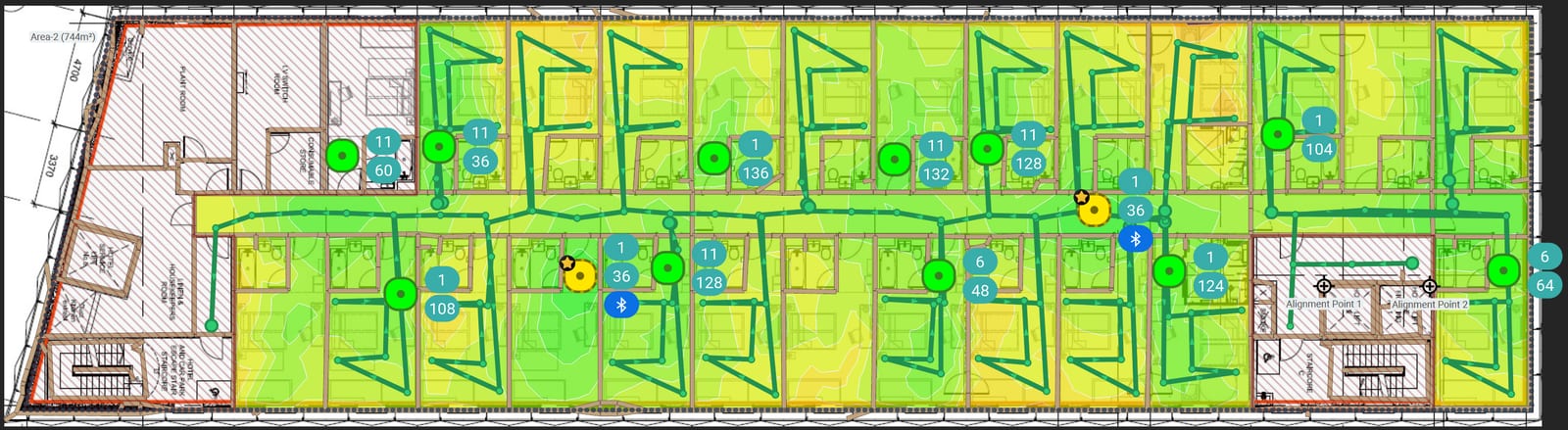
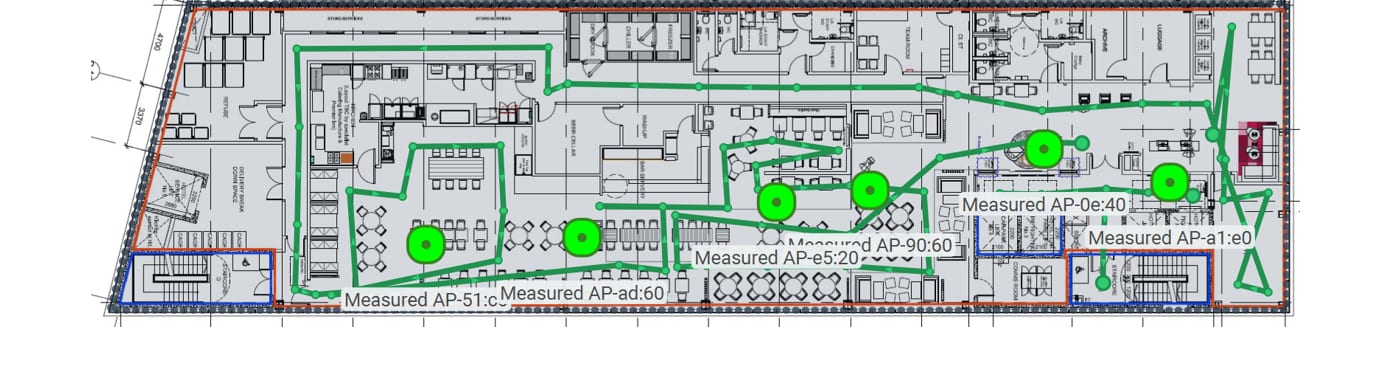
AP placement modelled against your actual building: brick, glass, kitchens, cold rooms, plant. Signal where you need it, deliberately not where you don't.
Roaming optimisation
Hand-helds and payment devices that move — between floors, front to back of house — need seamless handover between APs. We design and validate roaming paths explicitly.
Vendor-agnostic
We specify what your site needs. Nothing else.
Simplinet has no reseller targets and no preferred-vendor quota. We design first, then select hardware — Ubiquiti, Aruba, Cisco, Meraki, Ruckus or otherwise — based on what the design and your budget actually require. If your existing kit is capable, the design will say so, and you'll keep it.
Every design is delivered as a written document: AP placements, channel and power plan, switch and cabling requirements, kit list with reasoning, and the validation criteria we'll measure against after installation.
From survey to validated network
How a design comes together.
- 1
Survey
Predictive modelling or on-site measurement establishes the facts.
- 2
Design
Written design with placements, channel plan, kit list and reasoning.
- 3
Install
By us or your contractor — the design stands on its own.
- 4
Validate
A validation survey proves the design performs as specified.
Frequently asked questions
Do you only design networks you install?
No. Many clients take our design to their own installer or IT team. The design is complete and vendor-neutral — anyone competent can build from it.
Can you design around our existing hardware?
Yes, if it's capable. The survey tells us. We'd rather reuse good kit than sell you new kit.
What do we receive?
A written design document: AP placements on your floor plan, channel and power plan, capacity assumptions, kit list, cabling requirements, and pass/fail validation criteria.
What does wireless design cost?
Fixed price, quoted after a scoping call — it scales with site size and complexity, not with how much hardware we can attach to it.
Related services